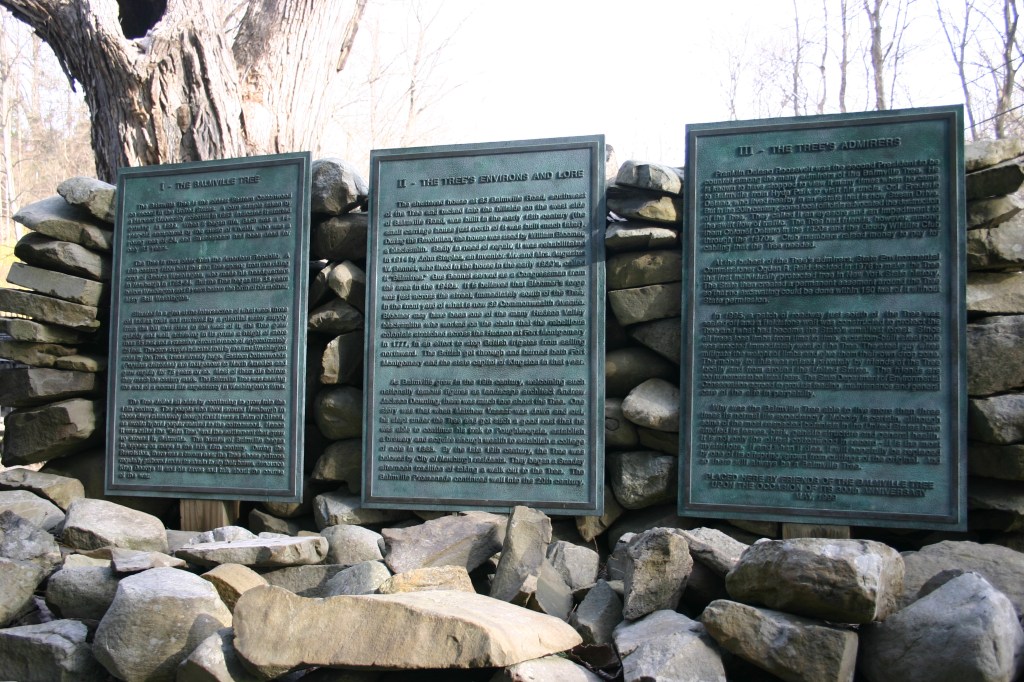
Balmville is known for its dramatic landscapes – from its impressive river views to its sprawling mansions and sculpted properties, but the Town of Newburgh hamlet is also known for one of its most diminutive features, as it is home to New York’s smallest state forest – a forest comprised of a single tree.
The Balmville Tree at the junction of Balmville and River Roads and Commonwealth Avenue is believed to be the oldest Eastern Cottonwood (Populus deltoides) tree in North America; samples taken from the tree during the 1950s suggest that it began growing around 1699. One of several historic markers beneath the tree notes that when the tree was in its infancy, “Bach was a 14-year-old enraptured by the music of Vivaldi, who was a young man of 24, and Shakespeare had been dead for only 83 years…33 years before [George] Washington and 9 years before the birth of his mother Mary Ball Washington.” The same sign notes that the tree was nearing the end of its normal life expectancy around the same time that George Washington would have ridden by it on his way to and from his headquarters in Newburgh.
At its peak, the tree reached more than 110 feet high, with a circumference of 25’, but storm damage brought it to its current height of about 85 feet tall. It was once thought to be a Balm of Gilead tree (a form of poplar), which provided the hamlet of Balmville with its name. The Balmville Tree was a popular gathering spot in the late 1700s, owing to a nearby tavern whose patrons would enjoy their purchases outside in nice weather.
By the early 19th century, the tree had become a popular destination, as Newburgh residents would walk to it on Sunday afternoons – a tradition that became known as the “Balmville Promenade.” Poems were written about the Balmville Tree, including one in 1902 that suggested a limb of the tree was removed in order to construct a violin.
By the following century, however, the tree was gaining a reputation as an eyesore and efforts were begun to cut it down. Local newspapers report that the first surgery to the tree was in 1906, when it was about 203 years old; numerous surgeries have followed. Colonel Frederick A. Delano, uncle of President Franklin Delano Roosevelt, was one early champion of the Balmville Tree. He lived on an estate in the area that is now Susan Drive in the hamlet, and petitioned the Newburgh Town Board to save the tree by boring holes in the ground beneath it to aid with water seepage. Other preservationists came to its rescue and have fought for the tree’s survival to the present day.
A group of Balmville residents and well-known activists including Pete Seeger led the charge to save the tree during the 1970s and raised funds, attracted volunteers and garnered publicity that led to the most concerted efforts to preserve the tree. In 1976, it became the first tree to be individually protected by New York State. A permanent easement was designated around it, which prohibits any excavation work within 150 of the tree. In 1995, a stone wall was built around it and a wooden walkway was constructed along the wall to allow for viewing of the historic markers, while cabling and guide wires help keep limbs in place.
Today, the tree and the land it sits on are considered protected, having been placed on the National Trust of Historic Places in 2000. (It is one of only three trees in the United States that are federally protected.) The area, at 348 square feet, is actually preserved as a state forest, making it New York’s smallest. It falls under the jurisdiction of the New York State Department of Environmental Conservation.
Despite its poor health – the tree reportedly is sustained by less than 12 inches of live wood in its center – the Balmville tree still stands tall as a symbol of Hudson Valley history and the dedication of those who strive to preserve the past. In turn, it offers Hudson Valley residents a unique way to mark the arrival of spring. One characteristic of the eastern cottonwood is the “flowers” or long, finger-like catkins that it produces in early spring and, after an undeniably long, difficult winter, the Balmville Tree’s catkins have emerged once again, welcoming spring to the Hudson Valley just as it has for the past three centuries.
UPDATE: In August of 2015, the Balmville Tree was declared a danger in its deteriorating state and was taken down. Sad Farewell to Balmville Tree




Leave a Reply