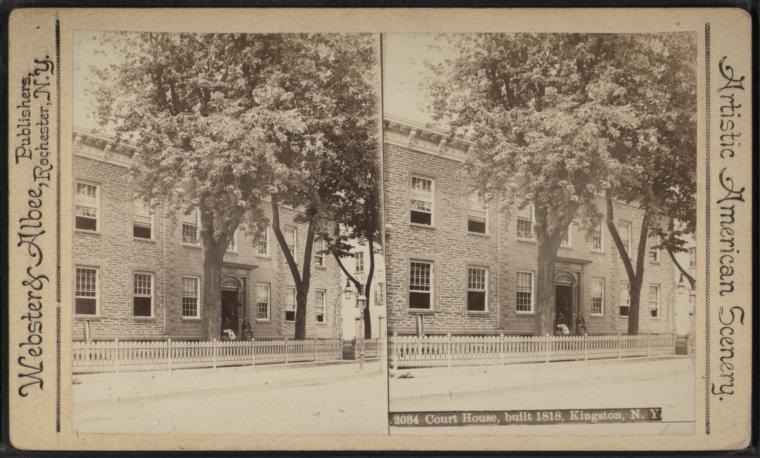
Owing to lax security and an aging facility, a number of escapes were attempted by inmates in the Ulster County Jail during its early history. A few efforts were so successful that they could have cleared the jail of its entire population, if not for the intervention of some of the prisoners housed in the jail.
One such incident took place in the summer of 1897, when four men created an escape route that allowed them to leave while their jailer was sleeping. At the time, all but the worst offenders were allowed a relative degree of freedom within the jail, which was then a wing behind the Ulster County Courthouse. It had become common practice to allow most prisoners to move throughout the jail with relative freedom, even during the overnight hours when only one jailer was on site. The evening of August 21, 1897, was no different, for of the seventeen male prisoners were housed in the jail, only one, Joseph Decker of Plattekill, was confined to a cell. (Decker, charged in the murder of farmer William Gardiner of Plattekill, was considered the most dangerous offender and was segregated from the other men.)
Four men, John Boylan, 24, a Kingston burglar, William Lasher, 27, a Saugerties thief, Charles Sullivan, who was serving a 55-day for stealing a bicycle in Saugerties, and Michael Reynolds of Kingston, carefully planned an escape route from their second floor confinement. Under the direction of Boylan, and over a period of several nights, the four men sawed through four inch and a quarter steel bars, and carefully removed the metalwork from the windows. To avoid notice during the day, the men used soap to hold the sawed pieces together until the late night hours of August 21, when they made their escape. Using a makeshift rope of blankets and sheets, they lowered themselves to the ground, fifty feet below.
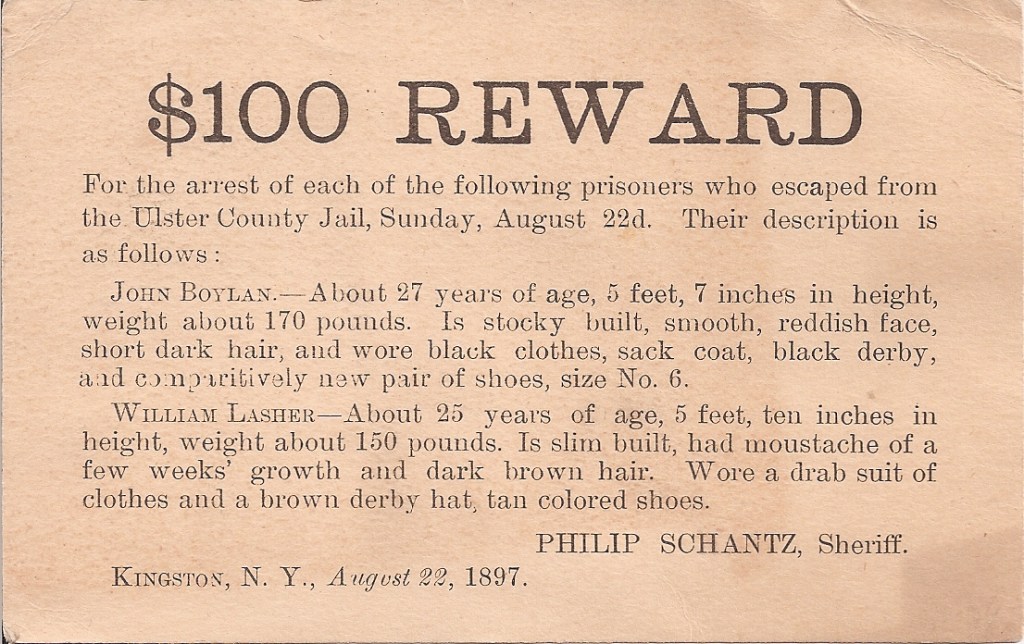
As the men made their getaway, Reynolds broke off from the group and returned to his Kingston home. He spent the evening with his sister, and apparently having a change of heart, decided to turn himself back in. As they walked along Wall Street, he located night watchman Paul Cabel, and informed him of the escape. He downplayed his own role by explaining that he had noticed the open window and simply followed the other three out to see where they were going. After trailing them to the West Shore Railroad, a distance of about a mile, he decided to return to his home. Reynolds asked Cabel to place him under arrest, so that it would appear as though he had been caught and had not turned himself in, thereby avoiding any retribution from his fellow inmates.
When Cabel entered the jail with Reynolds, they found warden Robert Smith asleep, and notified him of the second-floor escape. Smith quickly locked the other prisoners up in cells, and sent word to Sheriff Philip Schantz. (It was later reported that Joseph Decker, the only prisoner restricted to his own cell, slept through the entire incident.) Schantz posted a reward for Boylan and Lasher and notified police agencies throughout the state of the escape. All three men were captured within the year.
The bars on the jail windows were reinforced to prevent similar escape attempts, but just a year later a similar incident occurred, when Joe Savage, a burglar with three stints at Dannemora to his credit, Frank Stafford, jailed for highway robbery, Thomas Monroe, a burglar and John Davitt, charged with assault, absconded together. The group made their way through the jail by climbing up a water pipe, shimmying through a crawl space and cutting a hole in the ceiling that allowed them to drop into to the women’s side of the jail. They took advantage of the thin iron bars securing the windows in that area by bending them and easily breaking through the glass. Like their predecessors, they tied sheets and blankets together to form a rope and lowered themselves to the ground. The other men who were locked up with them at the time claimed that the escapees had told them of their plans and offered to help them leave as well, but they thought better of the plan and decided to remain in the jail.
In 1899, five prisoners escaped through a hole in the ceiling, and in 1900 another attempt was made from the very same route, this time with nearly the entire population of forty men ready to move. The men forced boards loose in the ceiling and set out supplies in the room above while waiting for the signal to leave. A lone inmate, who was ill and therefore unable to join the other men, informed the jailer of the plan, who was then able to lock the men up in cells while the ceiling was repaired.
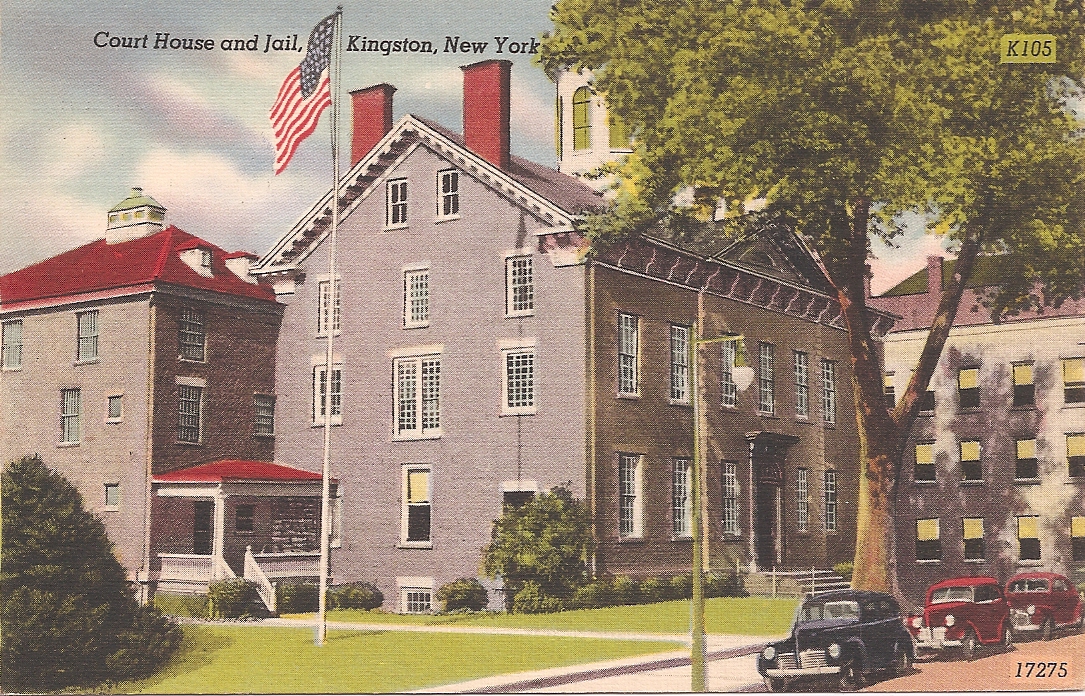
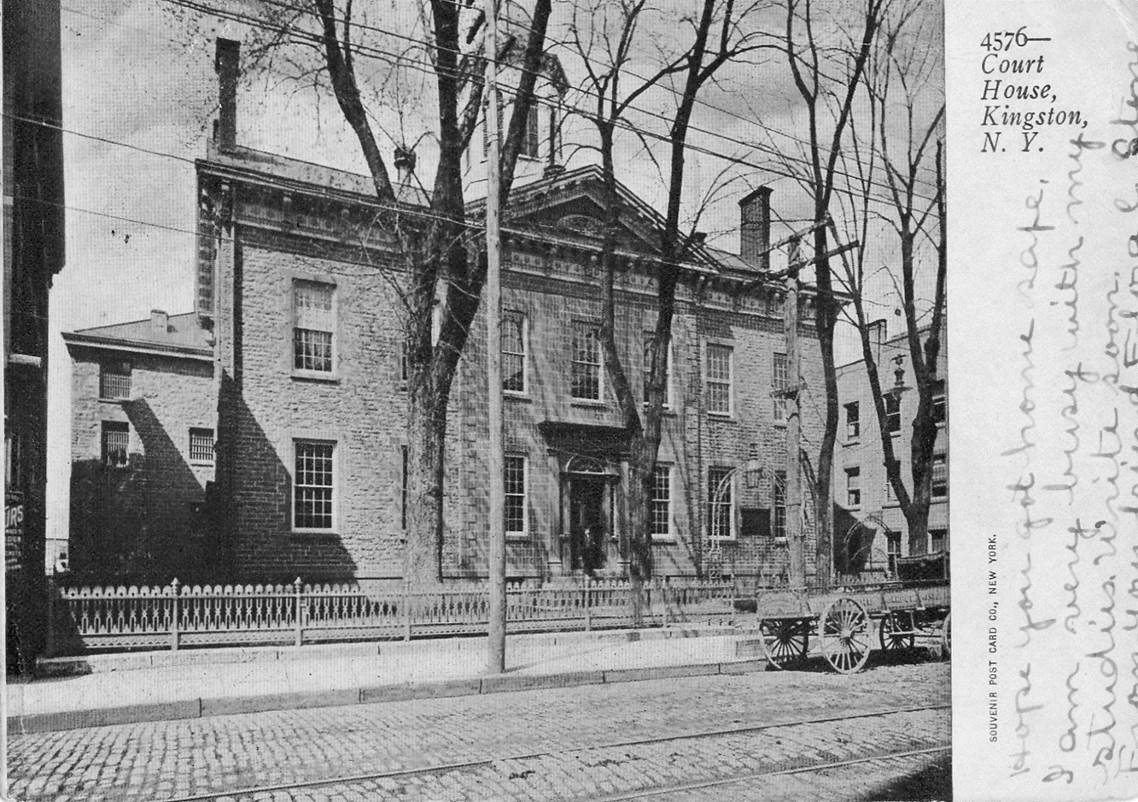
Security improved with the construction of the new jail behind the Ulster County Courthouse, completed in 1902. Designed by architect Myron S. Teller, the new structure featured four floors, with sixteen cells per floor, and was called “the most perfectly constructed jail in the state.” Most notably, the cells and the prisoners’ free areas were housed along an inside corridor, so that prisoners would not have access to windows.
Despite the modern construction, escapes continued over the next two decades, though they were much fewer in number. An inspection by the State Commission of Prisons in 1922 revealed that while the building itself was more secure, some practices had continued that allowed for the potential to escape. The inspectors’ report noted that prisoners were all moving freely throughout the kitchen and guards’ corridors, giving them access to windows and other escape routes, as well as the means to communicate with people on the outside. While praising other areas of the jail, such as the cleanliness of the kitchen and the ample rations of food for the inmates, the Commission inspectors firmly stated that there was “apparently little, if any, discipline inside the jail, and unless conditions in this jail are corrected, there will probably be trouble for the officials,” They specifically condemned the long-standing practice of allowing the prisoners to move about the jail by concluding that not only was it a violation of state law, it also “[placed] more opportunity for escape in the hands of the inmate.”



Leave a Reply