Originally published in the Southern Ulster Times, 10/19/2011
By the late 1800s, New York City’s need for water had outgrown the early reservoir and aqueduct system already in place and so the city turned to the Catskills for the needed resource. Maps were filed by the early 1890s that denoted properties in Ulster County that would serve to hold dams and a pipeline leading to the city. Despite the fact that the Town of Plattekill was not in the direct route of the proposed new Catskill Aqueduct, the construction of that pipeline in the adjacent towns of Gardiner and Shawangunk took its toll on many of those living in the western reaches of town.
At the time, New Hurley was an agricultural neighborhood that sat at the junction of the towns of Plattekill, Shawangunk and Gardiner. According to Shirley Anson, author of Friends and Neighbors: A Pictorial History of the Town of Plattekill and Southwest Lloyd, Ulster Co., NY, reports filed by a school inspector in 1881 indicated that the hamlet housed an active church as well as “a millinery, blacksmith and wagon-making establishment, a cider mill, store, post-office, railroad station, secular library, literary society, school house, parsonage…12 grape vineyards, 10 peach orchards and 55 houses.”
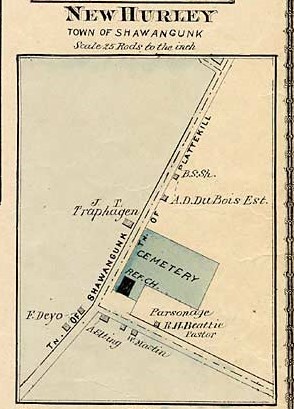
Shawangunk and Plattekill (Courtesy of Ulster County Archives https://clerk.ulstercountyny.gov/beers-atlas/pages/Page120.html)
By 1907, however, some of those properties and houses were deemed part of Section 5 for the construction of the new aqueduct, a stretch of land from roughly Libertyville Road in Gardiner, through New Hurley and up to the Orange County line near St. Elmo. New York City acquired 65 parcels of land consisting of about 430 acres of land within Section 5, many of which were from New Hurley landowners.
Construction on the new line was underway by 1908 and, although promised to be a three year project, continued until the first water was released through the tunnel in 1915. During the seven year construction period, New Hurley residents found that the project caused many disturbances to the area. One of the earliest issues was the construction of a small dam that immediately began leaking. One leak so disrupted the flow of water through the area that the neighborhood of Flint (near the present day intersection of Plains and New Hurley Road) was flooded for several days. While residents of Flint suffered flooding, other Plattekill residents closer to the Gardiner town line found that their well had run dry as the flow of water was diverted.
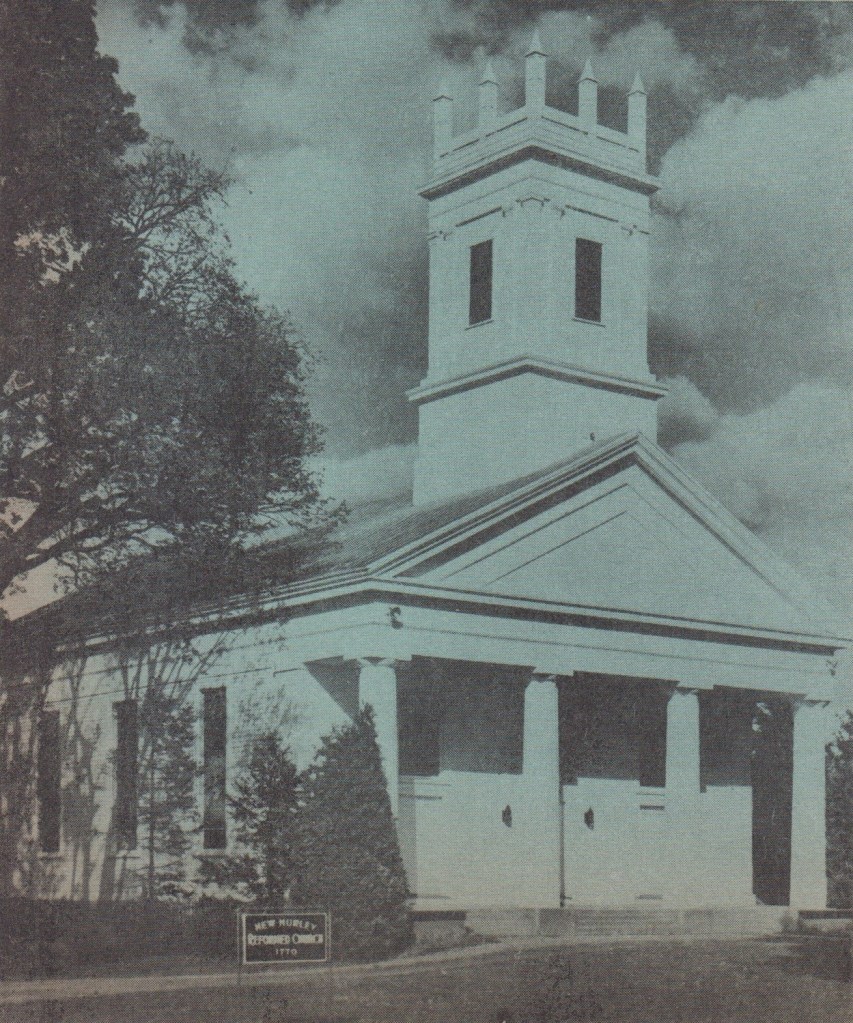
The New Hurley Church suffered many of the inconveniences of the construction. Although promises were made to block off the road to the church for a period of only a few days, it took over four months before it was reopened. An explosion in 1909 caused damage to dozens of windows in the church. A noisy steam shovel blocked the road for a lengthy period of time and at some points ran on Sundays. (According to reports in the Kingston Freeman, working on Sunday became quite common as a result of delays caused by workmen abandoning their responsibilities on the weekdays immediately following paydays.)
With the road blocked off, mail delivery was rerouted and often prevention from moving through the area. In 1908, the aqueduct company took over the New Hurley schoolhouse, which stood on the west side of present day Route 208 in Gardiner, and paid a fee to the three towns within its district to construct a new building on the east side of the road, on the border of Plattekill and Shawangunk. For a period of nearly a year, students attended school in the home of a Plattekill resident while waiting for the new schoolhouse to be constructed. The former school building was used as a workman’s camp until it suffered damage to its windows in the 1910 explosion and was torn down shortly after.
By 1908, an aqueduct police force was organized to deal with the growing number of criminal incidents along the construction route caused by the population surge and arrival of new businesses such as taverns. A precinct was created in New Hurley in 1910 under the direction of Deputy Inspector Thomas F. Dawkins and, at one point during that year, the New Hurley officers aided aqueduct workers who were overcome by gas while drying concrete for the tunnel. An increase in crime in the New Hurley area caused one local paper to note that “petty thieving seems to be a common occurrence now-a-days…a strong feeling of resentment exists quite generally.”
Adding to the resentment was the number of parcels that were condemned for use in the construction of the new aqueduct. Claims against New York City ranged from damage to fruit and locust trees to a loss of revenue when the blacksmith’s property and outbuildings were seized.
When the majority of the work on the tunnel was completed in 1913, there was little fanfare in the town of Plattekill. Three summer residents, however, reported a dubious tale of adventure in which the new aqueduct played a starring role. According to local newspapers, Harold Drake, Wilbur Frost and William DeWitt, New York City youths spending the summer in New Hurley, convinced a custodian guarding the New Hurley main to let them explore the tunnel on their bicycles. The boys claimed that, once inside, they were able to ride their bikes from New Hurley all the way to an exit in Orange County, nearly twenty miles away in Vails Gate. They reported that they moved quickly down the steep grade with the aid of lanterns attached to their bikes. The boys’ claims were never substantiated, although their story was later chronicled in Boy’s Life Magazine.
In the years between the filing of the first maps and the first rush of water through the pipes to New York City, the aqueduct running through Ulster County caused upheaval for the many who lost their land, homes and even their lives as a result of the construction. Although minor in comparison to what occurred in other Ulster County towns, the changes wrought by the arrival of the first aqueduct were remained ingrained of the memories of many Plattekill residents – and in the imaginations of at least three summer visitors-long after the construction of the Catskill Aqueduct was completed.
References
“Map of NYC’s Water Supply System.” https://extapps.dec.ny.gov/docs/water_pdf/nycsystem.pdf

 Bygone Hudson Valley
Leave a comment