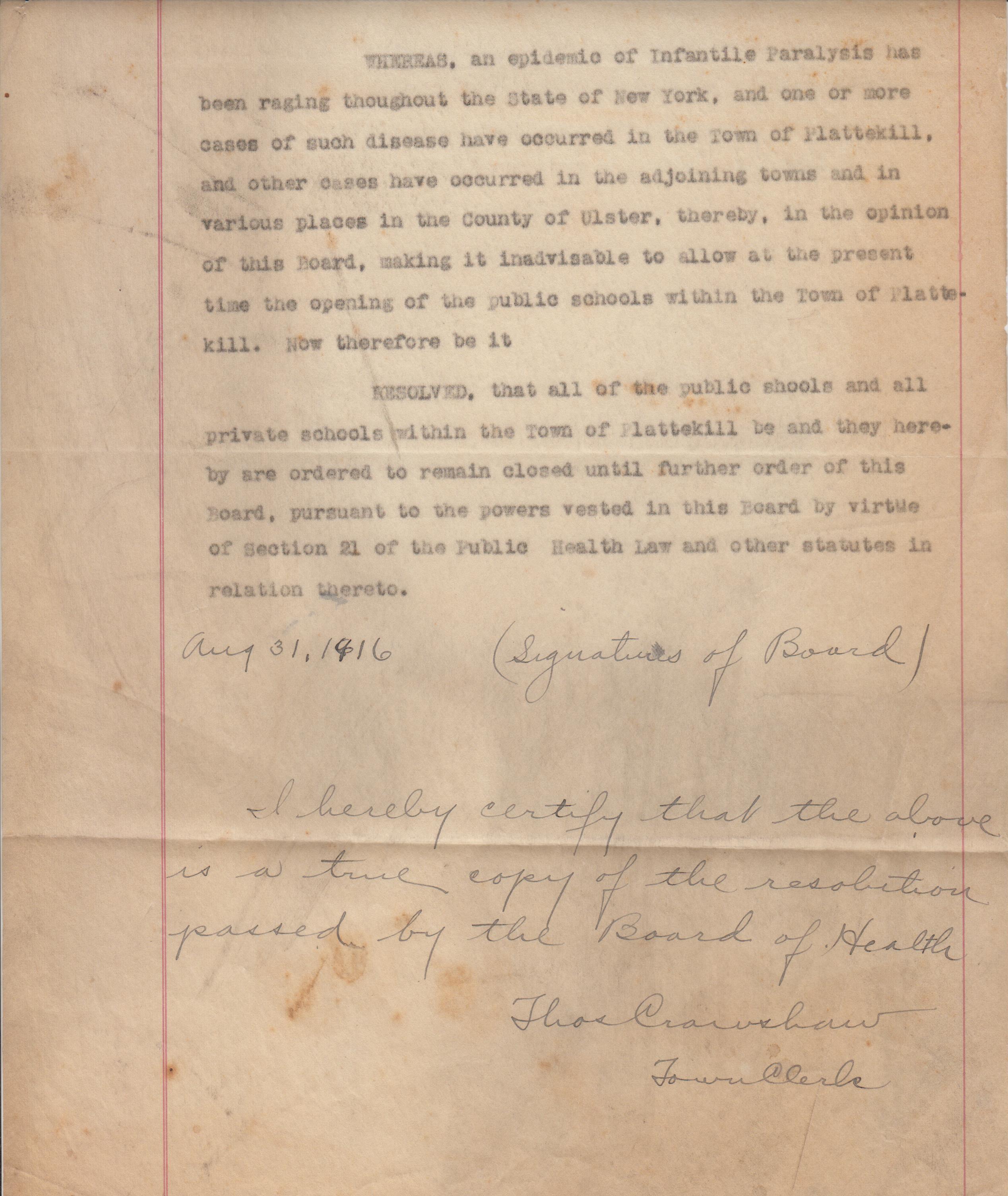
I recently came across the attached resolution in the town files regarding the 1916 polio (then known as infantile paralysis) epidemic in New York. So far it’s the only thing I’ve found specific to Plattekill during that particular time frame, but I did uncover some interesting stories regarding the local area. In June of 1916, an official announcement was made regarding the existence of an epidemic centered in Brooklyn, with more than 100 verified cases of infantile paralysis recorded by mid-month. The majority of cases involved children under the age of six. Within weeks, thousands of people fled New York’s metropolitan area and flocked to the Hudson Valley, New England and Pennsylvania. Throughout these areas, the names of families with active cases were made public in newspapers, and the afflicted were expected to remain in strict quarantine within their homes. As a result of the influx of summer visitors, bans were instituted in public places, including parks, movie theaters and swimming areas.
According to McGill Faculty of Medicine, “In 1916 no one knew how the disease was spread…There was no shortage of theories, from both medical and lay people. Some blamed summer fruits, ice cream, candy, maggots in the colon, insects, raw sewage, garbage, dust, poisonous caterpillars, mouldy flour, contaminated milk bottles or even bananas infected by tarantula spiders.” (http://www.medicine.mcgill.ca/…/…/DiseaseMaryDobsonPolio.pdf
) More than 80,000 stray cats and dogs, as well as abandoned household pets, were euthanized during this time over unfounded fears that they were responsible for transmitting the disease. (It was later learned that the disease is mostly transmitted by unfiltered drinking water contaminated by the feces of humans with the virus and does not survive in animals.)
.
Locally, second homeowners and boarders from New York City were asked to return to the city if it was discovered that any family members had fallen ill. By July, the City of Kingston had instituted a Quarantine Squad – volunteers who staffed the roads entering the city, as well as the railroad station, to ensure that vehicles carrying children who did not reside in the city would only pass through and would not stop for any reason. Drivers were provided with a timestamped card that had to be shown at each checkpoint. If it were determined that too much time had passed before leaving the city limits, the drivers were issued a court summons. That August, the Ulster County Fair remained open, but children under the age of 15 were prohibited from entering (some great information and pictures are available on the Hudson River Valley Heritage website:https://omeka2.hrvh.org/…/the-early-uls…/1916-polio-epidemic) J.S. Corning of Highland donated a cottage on his estate to be used as a children’s hospital when cases began appearing in the town of Lloyd. When more space was needed for the growing number of patients, he donated an additional home on the property to the county for temporary use as a field hospital. Many Ulster County schools were ordered to remain closed at the start of the school year, although opponents argued that since the disease affected primarily children who were not of school age, closing schools was an unnecessary step. By October, most of the schools were back in session.
By the end of the 1916-1917 outbreak, New York recorded approximately 9,000 cases of the disease, which caused 2,400 deaths and left 1,000 children paralyzed. Nationally, about 27,000 people contracted the virus, with more than 7000 recorded deaths. (It was not until 1955, following subsequent outbreaks, that an effective vaccine was developed and widely administered.)


 Bygone Hudson Valley
Leave a comment