The New Hurley Reformed Church congregation was officially formed on November 8, 1770. By 1773 the organization had purchased the land upon which the Church and part of the cemetery currently sit from Denne Relyea for five shillings. It is unknown how long the burial ground adjacent to the church has been in use, although there are a number of stones from the early 1800s and record of one dating back to 1790. The cemetery itself is listed on the 1875 Beers map. Numerous large stones had been erected behind the church by the early 1900s, as indicated by various postcards of the time. When Ronk and Stock catalogued gravestones at New Hurley in 1923, they called their work “Inscriptions of Stones of the Old and New Cemetery at New Hurley,” but the distinction between what would have been the old and new sections is not clear.
(Below: A 1910 postcard view of the New Hurley Reformed Church and cemetery.)
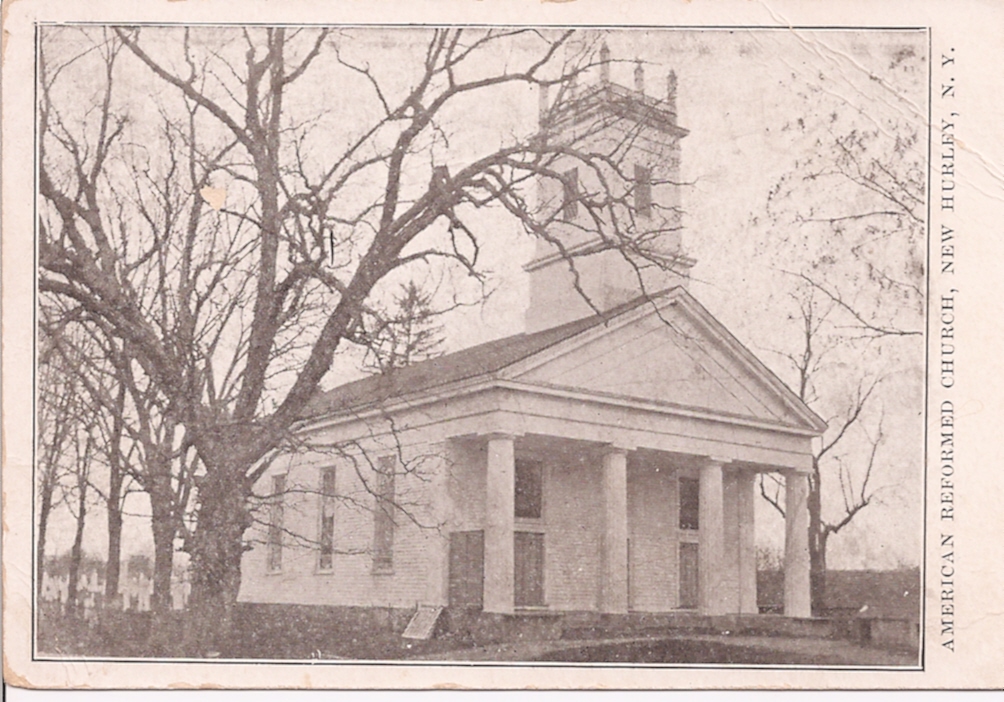
In 1905, the consistory of the New Hurley Dutch Reformed Church purchased an additional acre for the purpose of expanding the cemetery and offering plots for sale and four years later decided to institute a cemetery organization. A committee was formed to take charge of the process of incorporation, making it separate and distinct from the New Hurley Reformed Church. The new cemetery society was under the charge of Joseph I. Holmes, John Esterly, James T. Traphagen, Elias Mulford, Francis Garrison, Jr., Cornelius H. Masten and O.S. Gerow. By 1910 the New Hurley Cemetery Association had been formed with the following board of directors: John Esterly, James T. Traphagen, Zachariah C. Masten, John J. Sherwood, Eli Mackey, Elias Mulford, Francis Garrison, Jr., James Dennison and Daniel Gerow. At the first meeting of the Cemetery Association, held at the Savings Bank building in Newburgh, attendees pledged $900 to benefit the new organization.
The first job of the new association was to clean up the cemetery, which had fallen into disrepair. The grounds were mowed and stones repaired, an event noted by a correspondent for the Kingston Daily Freeman on August 24, 1911: “the repairing of tombstones in New Hurley Cemetery will be finished this week. One need but glance at the cemetery to notice the big improvement wrought thus far.”
By the early 1920s, the New Hurley Reformed Church Cemetery contained more than 1,100 tombstones. Poucher and Terwilliger had to make two visits, one on November 20, 1928 and another on July 8, 1930, in order to record all of the inscriptions they found.
The cemetery was enlarged again in 1937 when a strip of land on the northern side of the grounds was purchased from Edward Powell for the purpose of creating another roadway through the cemetery. According to surveys on file at the Ulster County Archives, an additional narrow parcel between the church driveway and the New York City Aqueduct was purchased from the New Hurley Reformed Church in 1939.
In 1918, the Reverend Thomas Powel Vernoll of the First Reformed Church of Paterson, NJ wrote an article entitled Memories of New Hurley Church, for the publication “Historic Wallkill and Hudson River Valleys.” Vernoll, who grew up in the Town of Newburgh and was baptized in the New Hurley Church at 9 years of age, recalled the following about the cemetery at the church:
Six miles by the shortest route spanned the distance and we were usually among the first to arrive. Be it remembered that prior to 1910 interments made in the church yard were unprotected by adequate guarantee for the future. It was not until May 28th, of the above named year, that a group of far-sighted and enterprising citizens secured a sufficient fund of money and effected what is now known as the New Hurley Cemetery association, Inc. under this new regime the ancient resting place – one of the oldest in the state – has undergone a most pleasing transformation, having been modernized into a place of attraction and beauty, also surrounded by adequate financial safeguards for generations to come. A quarter of an hour’s stroll through the grave yard before the first tolling of the bell announcing the hour of service concentrated every wandering thought and made the hour of public worship a happy blending of the living and the dead.


Leave a Reply