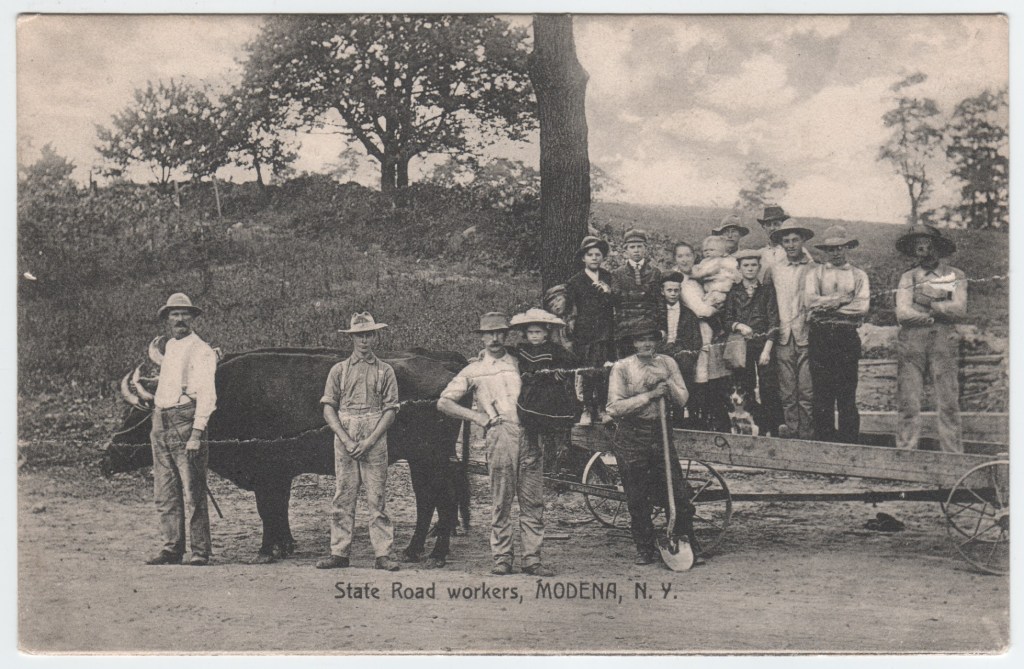
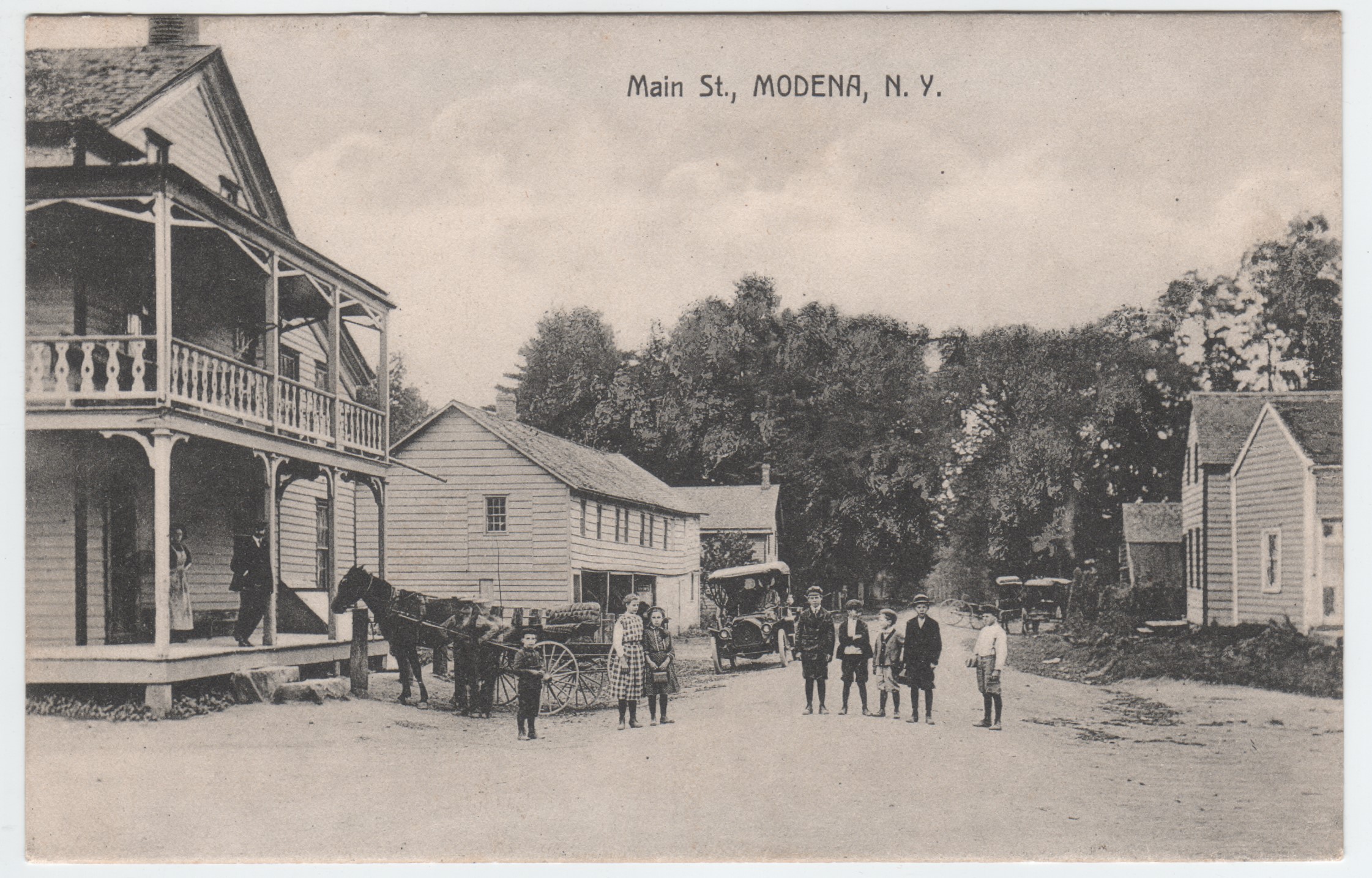
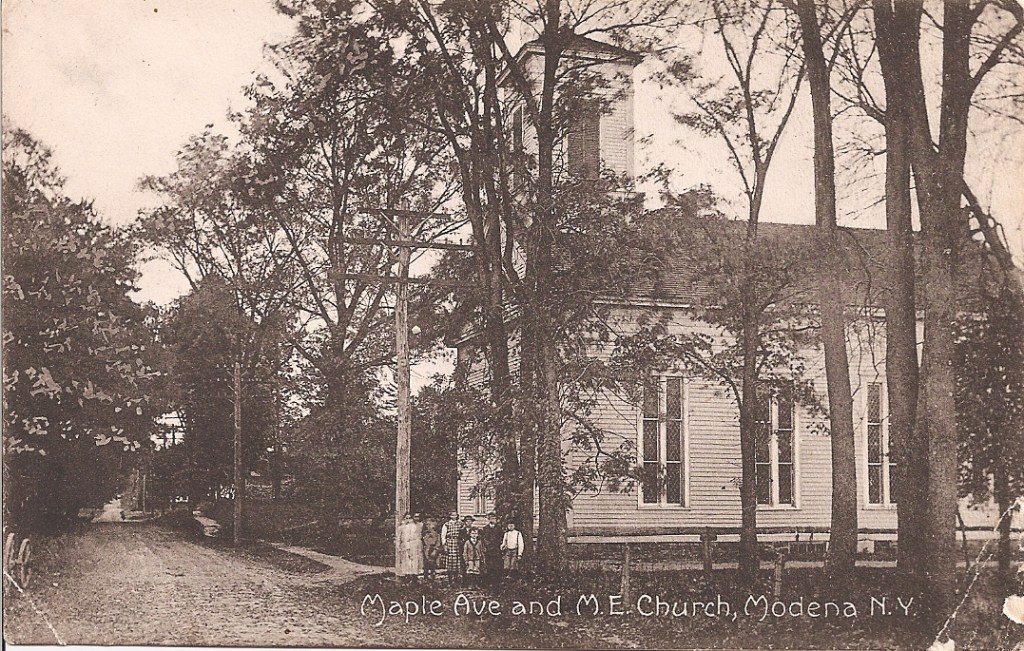
The series of 1911 postcards below are among my favorites from the town of Plattekill. Photographers would occasionally visit small towns and take a series of pictures that could then be sold as postcards. The photographer’s visit would be noted in the local paper, and people would come out to watch the pictures being taken and perhaps even become part of the pictures themselves. Often the same group of townspeople or their vehicles or even their pets or livestock would be posed in different locations around town for effect. Such is the case with this series, where the photographer used a group of Modena children as his models. The first depicts a scene along Maple Avenue (today’s Route 44/55) in the Plattekill hamlet of Modena. The image captures a brief respite for the workers as they, their team of oxen, and some local children (and a neighborhood dog!) pose for a picture amid their work surfacing the new state route running from the town of Lloyd through Plattekill to Gardiner.
The late Russ Coy of Modena was able to add another layer to the story when he identified his father, John Leonard Coy, as one of the children on the cart. Upon seeing the postcard Coy recognized his father immediately –the young boy dressed in black against the tree-because of the distinctive bowler hat he was wearing. According to Coy, his father is wearing the same hat in all pictures of him as a young boy – notice him in the Main Street postcard as well as the one taken in front of the Modena Methodist Church.
Not too long after these pictures were taken, John Leonard Coy suffered an accident related to the work on the state road. He and his friends would watch the state road workers and would often play nearby. While playing near stone piles along the road in Modena, Coy became trapped under a load of stone that shifted and was buried. Nearby workers rushed to his aid and moved stones with any available tools, including their bare hands. Coy was injured, but recovered from his wounds sufficiently that just a few years later he was able to serve his country as an Army cook in World War I.
 Bygone Hudson Valley
Leave a comment