Stories of the one-room schools in the region, many of which can still be found throughout the mid-Hudson, continue to be one of my favorite subjects when researching local history. Some of these buildings are even more intriguing perhaps, for the lack of information that remains despite housing hundreds or even thousands of students over the years. A particular favorite of mine is the Lattintown Schoolhouse in the Town of Marlborough, which survived for more than a century, only to be lost to a winter storm in 2008.
Around 1840, what is believed to be the original Lattintown School (District No. 8) was constructed in the hamlet known as Lattingtown or Lattintown. It was a one-room, grey structure, with a door facing the road. The school was just one facet of a busy hamlet that also contained “stores, wagon and blacksmith shops, a tannery and distillery, also two taverns, an undertaker, shoemaker, harness-maker, tailor and mechanics in early times,” according to C. M. Woolsey’s History of the Town of Marlborough, Ulster County, New York. The original school burned in the 1870s, and was replaced by a slightly larger building in 1877. Like many other early schoolhouses in the area, the “new” schoolhouse sat on land that had been deeded by a local family, in this case the Craft family of Lattintown, who owned property adjoining the school.
Students in the Lattintown School learned their lessons while seated upon long wooden benches rather than in individual seats. Neighbors and school trustees would provide water and firewood for the school as well as room and board for many of the teachers. Stories passed down about the school include the mention of a teacher’s desk that had a large door – rumor had it that students who misbehaved could be placed into the cubby as punishment.
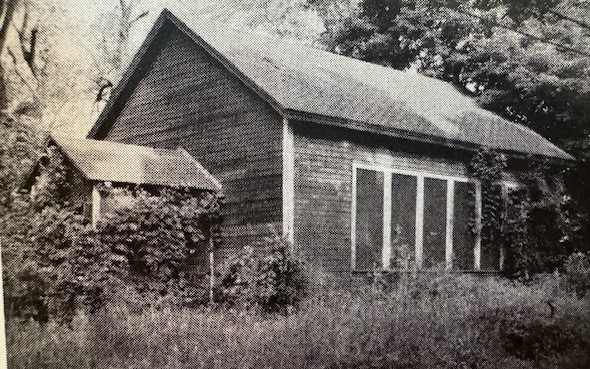
Under the guidance of the New York State Education Department, a number of improvements to the school were made in the early 1920s. New additions to the schoolhouse included the installation of a furnace, a ventilation system and seats that replaced the wooden benches. A well was also dug on the property, which relieved neighboring landowners from having to supply water for the school each morning. The school was also repainted in the bright red that had become a distinctive feature of rural schools.
Many early schoolhouses has separate entrances for boys and girls, but the Lattintown School boasted a slightly different system: a 1967 article in the Newburgh Evening News noted that early on the school only had a single door that was used primarily by the girls, while the boys would often make a “quick exit” out the “small, narrow windows.”
With centralization of rural school districts in the 1930s and 1940s came the closure of many of the one-room schools, including the Lattintown School. The building remained in use by various groups, including the Lattingtown Gun Club, but in its later years was primarily used for storage. Attempts were made by the Marlborough Historical Society and the Marlboro Central School District to save the building for the purpose of a museum or an educational site.
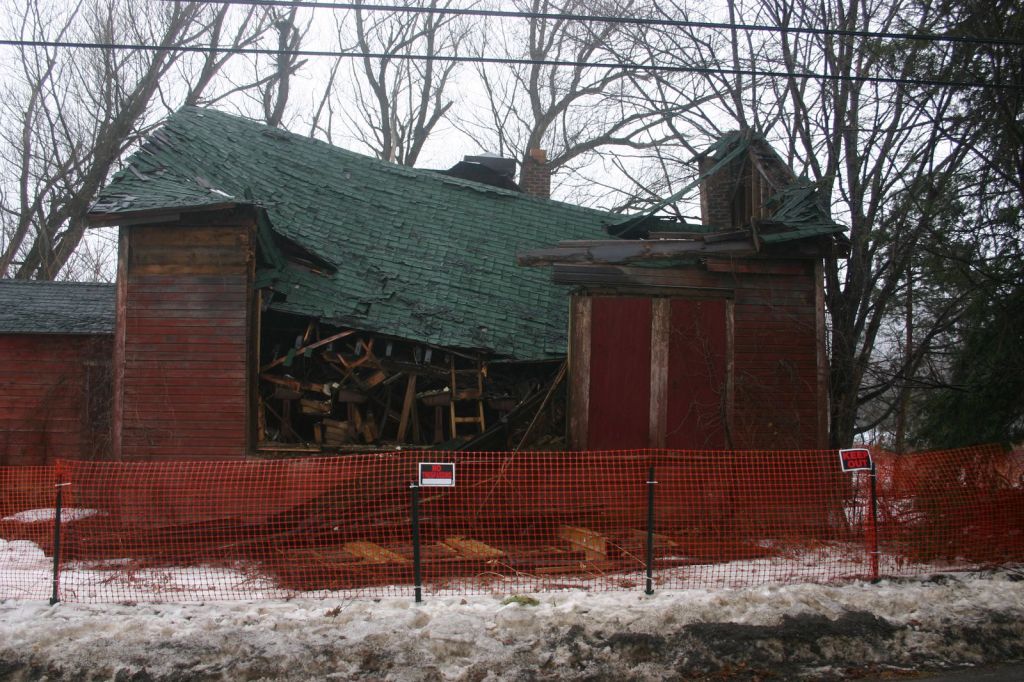
Mother Nature, however, had different plans and on Christmas Eve of 2008 a heavy storm with snow and ice caused irreparable damage to the building. The roof caved in, and subsequent inspections by engineers showed extreme damage to the aged foundation and walls.
The building was subsequently razed, and the lot along Lattintown Road now stands vacant. Memories of the Lattintown School are fading and few pictures and documents remain; the hamlet itself is now primarily residential and the businesses that once thrived in the area are long gone.
I recently came across one document, written in 1995, that captured my attention and prompted me to start exploring the history of the school. My grandmother, who grew up next door to the Lattingtown School and attended school there along with her siblings, recorded her most vivid memory of the school, circa 1920:
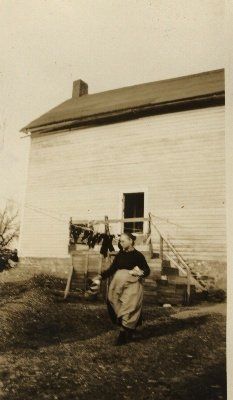
When I was quite young and in the third or fourth grade, we had a teacher by the name of Mrs. Manion. She had about fifty pupils in a one room schoolhouse. I can’t remember what I said or did but she kept me in and let all the other kids go outside during recess. She yelled at me for whatever reason and then told me to go outside. When my brother Vincent asked me why she kept me in I told him in Italian as I didn’t want the other kids to hear. Suddenly Mrs. Manion opened the window and as both Vincent and I looked up she said while pointing her finger at me, “Stop telling your brother all those lies, I understood everything you said to him.” Needless to say – gullible me – I believed her. It was a year or so later that I realized she didn’t understand Italian!
Although the Lattintown Schoolhouse is gone, this short piece, written as part of a larger story about her extended family, captures a moment in time from the perspective of a student at the one-room school and helps keep the memory of the school alive. It’s my hope to capture as many of these types of stories as possible about the region’s schools as possible, before they – and the schools themselves- are simply lost to time.



Leave a Reply