The new trestle work on the West Shore Railroad at Pegg’s Point, a short distance below Marlborough, has been completed, and all trains now pass over it. This is the spot where so many slides have occurred, and has been a source of almost endless expense to the Company. For some time past only one track could be used there, and all trains had to come to a stop. It is now thought that there will be no further trouble at that place. ~1883 West Shore Railroad Note appearing in the Poughkeepsie Eagle-News
Within the town of Marlborough a certain spot along the line of the West Shore Railroad, called Peg’s Point or Pegg’s Point, was the source of several curious happenings. During the existence of the West Shore line, the area became known for strange happenings and natural disasters that claimed more than one life.
As the railroad constructed a line through the area, Peg’s Point began to gain a reputation for being the toughest stretch of the line. Drilling and blasting were necessary to cut through the rock along the shoreline.
Laborers boarded in a large shanty under the direction of a Mrs. Horan, and kept a variety of dogs there for company. When the work on that section of the line was completed, the men and Mrs. Horan left, abandoning the dogs. The dogs remained and their population grew, with local newspapers reporting that they had even begin “mating with foxes” (more likely the coyotes who also populated the shoreline.) Some of the early dogs were Saint Bernards, and the ensuing wild pack was large in stature and said to be adept at surviving by foraging in the heavily wooded area of Peg’s Point. Passengers on the new line would often see “the wild dogs of Peggs Point” from the windows of the train, standing on the rocky ledges above the tracks. Some attempts were capture the feral pups, which were labeled as “grotesque” due to their size, ferocity and questionable lineage. In 1886, an article in the New York Times indicated that boatmen on the Hudson came to rely on the dogs as “a lighthouse and foghorn combined,” for their howls allowed those on the river to locate Peg’s Point even in the dark and fog.
Watchman along the line served to be on the lookout for rockslides and other hazards along the tracks. They watched from small shanties constructed along the line. Robert Wade, a flagman for the West Shore line, was known as a hardworking man who kept careful watch of the rough terrain near his post at Peg’s Point. He would return home each evening to his nineteen-year-old wife Annie, described as a “pretty brunette, rather below the medium height, and well built,” who was so shy that she would not even look up when passing neighbors on the street. Married at age fifteen, she lived quietly with Wade near Peg’s Point and interacted very little with her neighbors. On a July evening in 1884, Wade returned home to find the door locked and Annie gone – along with two months worth of his pay that she had planned to take to Marlborough that morning to pay rent and outstanding bills. A note left behind Annie’s sewing machine indicated that she had gone on the train to Highland to visit her brother, but it was quickly determined that she had not boarded the train that day.
Despite an extensive search, Annie was nowhere to be found, and neighbors could not determine the last time they had seen the reclusive woman. Police scoured nearby farms, where itinerant berry pickers were questioned about the woman’s disappearance, and newspapers from the Hudson Valley to New York City put out requests for any information regarding the missing woman.
It was soon noted that young man by the name of Patrick Ward, who had been working on a nearby farm, had also gone missing on the same day as Annie Wade. When a description of Ward was circulated, witnesses came forth describing a couple similar in appearance to Wade and Ward who had been meeting in the Highland area and were seen together one afternoon making their way to New York City. Upon hearing the news, Robert Wade returned to his home, gave a way all of his belongings, and stayed in the watchman’s shanty. Within a few short days, he left his post at Peg’s Point without notice, and simply disappeared from his job with the railroad and the town of Marlborough altogether, not to be heard from again.
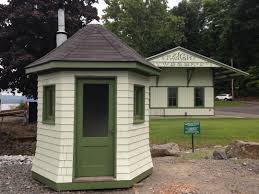
The Peg’s Point watchman’s shanty, located today at the Milton Landing in Marlborough, N.Y.



Leave a Reply