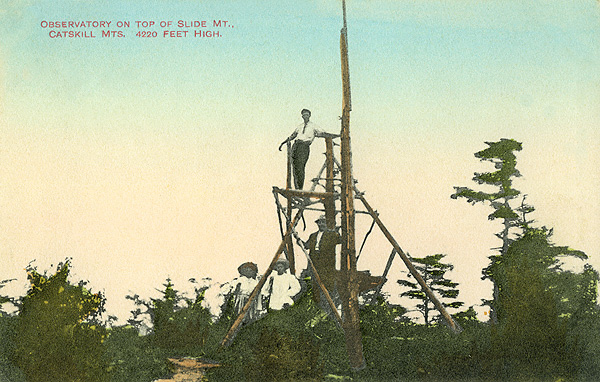
In an earlier entry, I wrote about the Belleayre Fire Tower, which served as a fire observation tower for more than 60 years before its closure and eventual removal. The service of another nearby tower fire observation tower, however, was much shorter – less than a full year to be exact.
With the advent of fire towers in the Catskills and Adirondacks during the early 1900s, a logical choice for placement of one such tower seemed to be Slide Mountain, the highest peak in the Catskill range. In the decades prior, Slide Mountain had garnered much attention. Discovered to be the highest peak in the Catskills as part of a survey conducted in the late 1870s, by the early 1880s the mountain had become a choice destination for hikers. Hiking parties took on the challenge of ascending the mountain and spending time at the summit picnicking and camping. The young women of Vassar College were frequent visitors to the mountain, and their visits were often the subject of humorous articles in the local newspapers. One account in 1909 described the ladies gathering wet green sticks for a fire because they were cleaner than dry brown wood, stopping frequently to ask for directions to the top and eating hearty lunches of cucumber sandwiches that had been cut into fancy shapes…nevertheless, newspaper correspondents also noted that local residents welcomed the women warmly whenever they arrived for a day trip to Slide.
James Dutcher, of Big Indian in the town of Shandaken, played an important role in Slide Mountain’s growing fame. The Slide Mountain postmaster and owner of the Panther Mountain House resort near Slide capitalized on the mountain’s popularity by designing trails for guests that led to the summit and serving as a trail guide. Dutcher knew the land well from his work as a fire warden and fish and game protector for Big Indian, and, according to his biographical sketch in the Ulster County Biographical Record, was “the best known and most reliable guide in this section of the Catskills.” He also built a succession of observation towers at the summit for guests to use and created a path to the top that include resting benches and stone steps to make the climb easier for those not accustomed to such an ascent.
The New York State Legislature aided Dutcher’s efforts in 1891 by voting to provide the first public funds for Forest Preserve trail development. The funds were allocated to the lands of the Slide Mountain Wilderness so that a public trail to the summit could be constructed. More and more visitors took advantage of the growing network of trails, including noted naturalist John Burroughs, who wrote of the sights in his 1910 book In the Catskills as well as in other publications:
The low, stunted growth of spruce and fir which clothes the top of Slide has been cut away over a small space on the highest point, laying open the view on nearly all sides. Here we sat down and enjoyed our triumph. We saw the world as the hawk or the balloonist sees it when he is three thousand feet in the air… To the east we looked over the near-by Wittenberg range to the Hudson and beyond; to the south, Peak-o’-Moose, with its sharp crest, and Table Mountain, with its long level top, were the two conspicuous objects; in the west, Mt. Graham and Double Top, about three thousand eight hundred feet each, arrested the eye; while in our front to the north we looked over the top of Panther Mountain to the multitudinous peaks of the northern Catskills. All was mountain and forest on every hand. Civilization seemed to have done little more than to have scratched this rough, shaggy surface of the earth here and there. In any such view, the wild, the aboriginal, the geographical greatly predominate. The works of man dwindle, and the original features of the huge globe come out. Every single object or point is dwarfed; the valley of the Hudson is only a wrinkle in the earth’s surface. You discover with a feeling of surprise that the great thing is the earth itself, which stretches away on every hand so far beyond your ken.
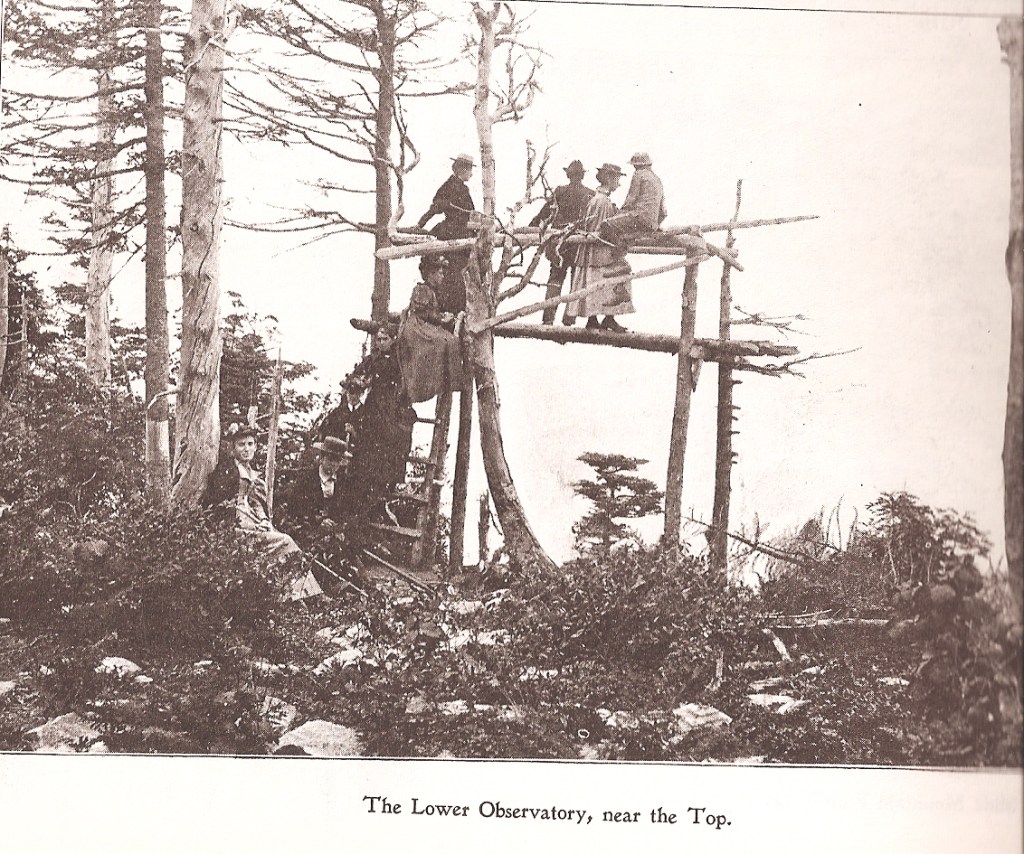
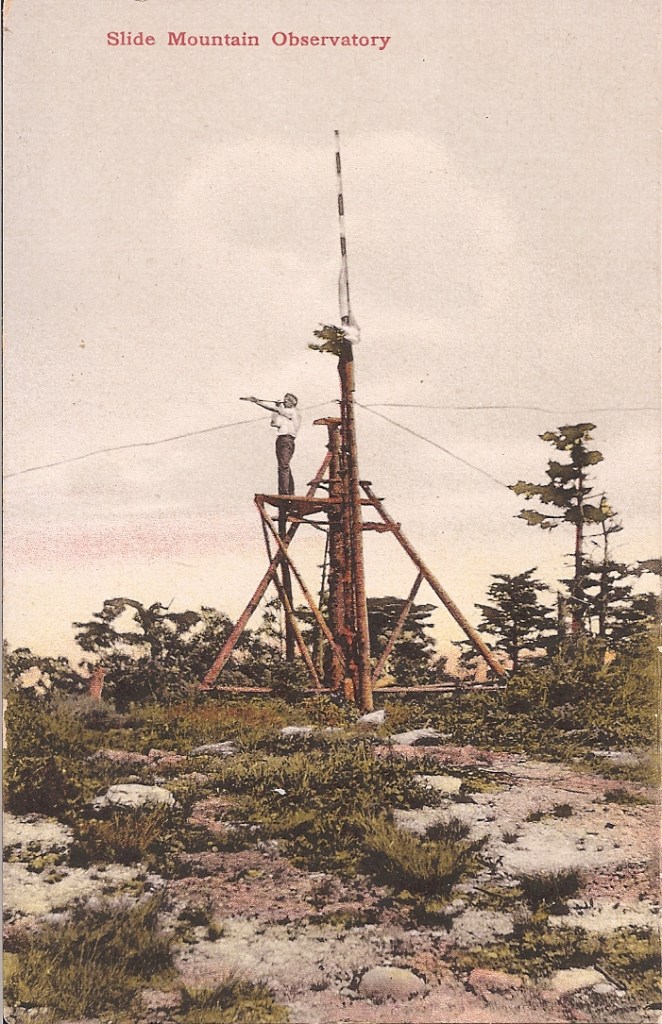
In 1911, the state’s Conservation Commission took advantage of the unobstructed views from Slide to construct a fire observation tower at the summit, along with a cabin for the fire observer. Eben Chase of Slide Mountain was hired in May of 1912 as the fire observer, and remained on site until November of that year.
What had not been accounted for was the fog that often covered Slide. The fog drastically reduced visibility, rendering the fire observation tower nearly useless at times. By the end of the first year, the decision was made to close the fire observation tower and to take advantage of other nearby locations instead. The tower was officially closed in the fall of 1912 and removed from the site by 1916.
In 1936, the state’s Conservation Department brought another tower to the summit, this time a steel structure erected purely as an observatory for the hikers who continued to flock to the mountain. Efforts were made in 1948 to create a highway that would lead to the observatory. Senator Arthur A. Wicks of Kingston and Assemblyman John F. Wadlin of Highland proposed the creation of a state monument dedicated to the men and women who had served in World War II. The monument would be situated at Slide’s summit. The design would be similar to a monument and observatory dedicated to those who served during World War I, which had been constructed previously on Whiteface Mountain in the Adirondacks. The resolution ultimately was not adopted, and though other plans were made to enhance the observatory at Slide over the years, little action was taken. By 1968, the tower had been vandalized so severely that the decision was made to remove it.
By the 1990s, a wilderness plan for the Slide Mountain region had been developed by the New York State Department of Environmental Conservation. Part of the plan determined that the region should remain as undisturbed as possible, thereby ensuring that no further development, including any future observation towers, would take place at the summit.
A hike to the summit of Slide Mountain is still possible today, and thanks to conservation efforts in the region, the views are much the same as they were in the late 1800s, as described by Richard Lionel De Lisser in his Picturesque Ulster:
The view from Slide Mountain must be seen, and that more than once, to be comprehended. What one sees today, he may never see again. The atmosphere, clouds and light ever changing wipe out the picture of the moment to substitute another….the view obtained will never be forgotten.
Additional information on the Slide Mountain Wilderness lands, including hiking maps and camping information, can be found on the New York State Department of Environmental Conservation’s Forest Preserve Unit website: http://www.dec.ny.gov/lands/9150.html
| OTHER INFORMATION | |
| Around 50 years ago, Slide Mountain had a metal fire tower on the top of the mountain. At the summit you can still see some of the concrete pads the fire tower sat on. Prior to the metal fire tower, there was a wood fire tower. Many years ago, the beginning of the Slide-Cornell-Wittenberg Trail to the summit of Slide Mountain was a jeep trail for the rangers who ran the fire tower. After the fire towers closes, the DEC put a metal gate around 3,700′. Recently, the gate was removed by the DEC. https://www.catskillmountaineer.com/SMW-slide.html |
Further Research:
https://catskillcenter.org/fire-tower-project

 Bygone Hudson Valley
Leave a comment